

 SGD
 USD
 GBP
 EUR
 INR
 ZAR
 AUD
 CAD
 MYR
 THB
 HKD
 BRL
 AED
ACME Certificates for Automated SSL Management
Simplify SSL certificate issuance and renewal with Sectigo ACME certificates. Choose DV or OV validation with single-domain, SAN or wildcard coverage, and let a configured ACME client handle recurring certificate requests and renewals across your websites and services.

| Brand |  |
|
|---|---|---|
| Product Name | Sectigo ACME Certificate - DV |
Sectigo ACME Certificate - OV |
| Price | SG$ 25.40/yr. | SG$ 114.30/yr. |
| License | 3 years | 3 years |
| Buy / Renew | Buy Now | Buy Now |
| Validation | Domain Validation (DV) | Organization Validation (OV) |
| Issuance Time | Within minutes | 1–3 business days |
| Certificate Lifetime | Up to 90 days, auto-renewed | Up to 90 days, auto-renewed |
| Company Name in Certificate | - |  |
| Warranty | USD $500,000 | USD $1,000,000 |
| Wildcard Support | |
|
| Multi-Domain (SAN) | |
|
| External Account Binding (EAB) | |
|
| Unlimited Reissue | |
|
| Key Types | RSA 2048-bit or higher / ECDSA P-256 or P-384 | RSA 2048-bit or higher / ECDSA P-256 or P-384 |
| Refund | 30-Day Refund | 30-Day Refund |
What is an ACME Certificate?
An ACME certificate is an SSL/TLS certificate issued and renewed using the Automatic Certificate Management Environment (ACME) protocol. The protocol defines how an ACME client communicates with a certificate authority; the certificate enables your website or service to establish secure TLS connections.
The client handles certificate requests, domain-control checks and retrieval. A supported integration can also automate installation on your server.
Key Features of ACME Certificates

Automated Certificate Renewal

Ready for Short Certificate Lifetimes

Unlimited Certificate Issuance

Automation Across Your Servers

Single, SAN & Wildcard Coverage

Certificates Issued by Sectigo
How ACME Certificate Automation Works
ACME SSL certificate setup – from subscription and client registration to automated renewal.
Order ACME Certificate
Buy ACME SSL Certificate – choose DV or OV, add your domains and receive EAB credentials for client registration.
Register ACME Client
Configure a compatible EAB-capable client with the supplied Sectigo directory URL and account credentials. Use the endpoint for your validation level.
Validate Your Domains
Configure HTTP-01 or DNS-01 so your ACME client can complete domain-control checks when required. Verify validation access before requesting certificates.
Issue & Install
The client submits a CSR and retrieves the certificate. Configure and test installation of the certificate and chain, including any required service reload.
Renew Automatically
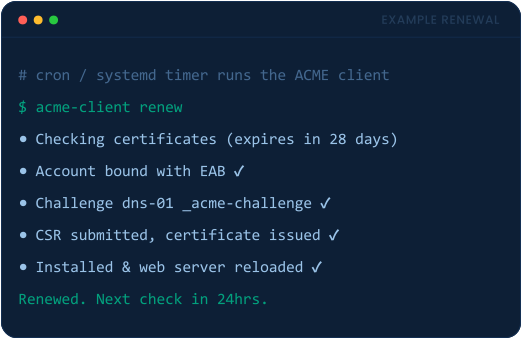
Once configured, the ACME client automatically renews and installs certificates before expiry throughout the active subscription term.
Why Shorter Certificate Lifetimes Make ACME More Valuable
The CA/Browser Forum’s approved schedule progressively shortens the maximum validity of newly issued publicly trusted TLS certificates.
About one renewal a year
Two renewals a year
Four renewals a year
Eight or more renewals a year
As certificate lifetimes shorten, requests, validation and installation become more frequent. A configured ACME workflow handles these recurring tasks across your domains and servers, reducing manual work and helping your team keep certificate replacements on schedule.
Sectigo ACME certificates are valid for up to 90 days per issuance. During an active subscription, your configured client automatically requests replacements before expiry and installs them through a supported integration, reducing the need for repeated manual deployment.
ACME SSL vs. Manually Renewed SSL Certificates
| ACME Automation | Manual Certificate Management | |
|---|---|---|
| Issuance | Client generates keys and CSR, answers the challenge and downloads the certificate | Manually generate a CSR, complete validation and download the certificate |
| Installation | Installed by the client or a deploy hook | Copied and configured on every server |
| Renewal | Automatic, before expiry | Repeat the entire process each cycle |
| Short-lifetime readiness | Repeatable renewal workflow; settings must remain suitable for the issued lifetime | Workload grows with every reduction |
| Scaling to many domains | Add authorized domains and configure validation and deployment | Manual tasks increase across domains and servers |
| Outage risk | Can reduce missed-renewal risk when monitored | Depends on tracking and execution; missed expiry can interrupt HTTPS |
| Best for | DevOps, hosting providers, SaaS, any team with more than a handful of sites | Small deployments with manageable manual renewal needs |
DV or OV: Which ACME Certificate Do You Need?
Both support ACME enrollment and renewal. Choose the validation level based on the identity your certificate needs to establish.
Choose Sectigo ACME DV if…
- Domain-control verification meets your certificate requirements
- Your certificate policy permits domain-validated SSL
- You need issuance without organization pre-validation
- You want a lower-cost subscription for domain authentication
Choose Sectigo ACME OV if…
- Verified legal organization details must appear in the certificate
- Internal policy or procurement requires organization validation
- Partners or security reviewers need to inspect your organization identity
- You need automated issuance linked to a pre-validated organization
ACME Client Compatibility Across Server Environments
Use an ACME v2 client with EAB support, a compatible validation method and the installation integration your environment needs.
ACME Certificate Setup Assistance
Get help choosing DV or OV, planning domain coverage and connecting your ACME client with EAB credentials.


Policy


