

 USD
USD  USD
USD  GBP
GBP  EUR
EUR  INR
INR  ZAR
ZAR  AUD
AUD  CAD
CAD  MYR
MYR  SGD
SGD  THB
THB  HKD
HKD  BRL
BRL  AED
AED 
Encryption is a control layer, standing between your production database and a ransom note. It protects data at rest, in motion, and inside applications. If the algorithm is weak, everything above it is exposed, TLS, VPNs, disk encryption, authentication systems, all of it.
AES and DES both come from the same world: symmetric block ciphers, single secret key, predictable structure. That’s where the similarity ends. DES was built for hardware from another era. Its key space is small enough to be brute-forced with rented cloud time. It survives today only because legacy systems still depend on it.
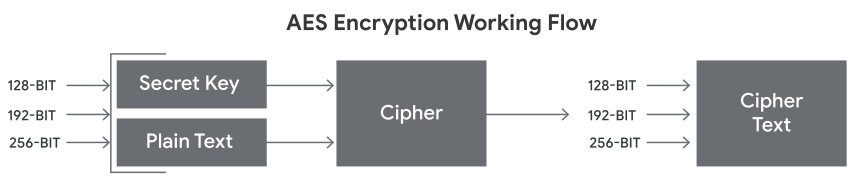
AES was created to replace DES, not extend it. It uses 128-bit blocks, supports 128/192/256-bit keys, and scales across software and hardware platforms. It is fast, resistant to known cryptanalytic attacks, and widely implemented in modern protocols.
This guide breaks down AES vs DES – how they’re built, how they behave under real workloads, and why one is still safe to deploy while the other is not.
What is DES (Data Encryption Standard)?
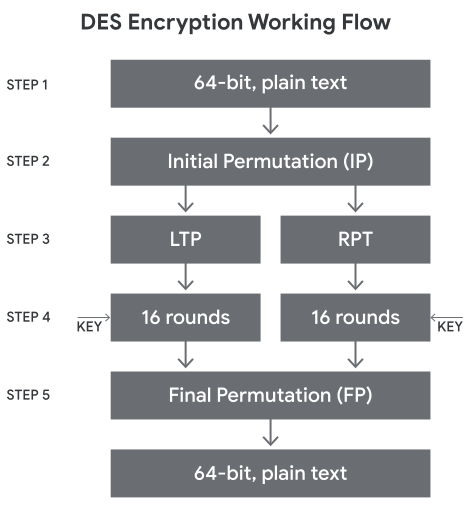
Data Encryption Standard (DES) is a symmetric cipher, which is mostly used for legacy applications. First developed by IBM, it was initially used to protect sensitive US government data. DES operates on 64-bit blocks of data using an effective 56-bit key.
Basic Operating Principle of DES
DES is constructed on a fundamental design referred to as the Feistel network (or Feistel cipher). These are the basic components and the principle of how DES functions,
- Block Splitting- An algorithm that assists the DES standard takes a 64-bit block of plain text and breaks it into two equal parts. These are referred to as the left and right halves.
- Rounds- The information undergoes 16 equal rounds of processing.
- Transformation- In every round, half the data is scrambled with a subkey (derived from the main key) by a defined function. This function performs expansion, substitution using S-boxes, and permutation using a P-box as a single transformation step.
- Feistel Combination: The output of the round function is XORed with the left half.
- Swap and Recombine: The halves are swapped after each round. After the final round, the two halves are recombined to form the ciphertext block.
What is AES (Advanced Encryption Standard)?
Advanced Encryption Standard (AES) refers to a symmetric block cipher that was developed as a product of the American National Institute of Standards and Technology (NIST) in 2001. It is developed with the aim of securing confidential electronic information.
General Organization and Security
AES uses a Substitution-Permutation Network (SPN). In this design, AES will be able to handle the entire block of data in parallel at each round, improving diffusion and efficiency.
AES processes 128-bit fixed- sized blocks of data (a 4×4 block of bytes, which is the state) and uses a series of transformations on 10, 12, or 14 rounds, depending on the key size.
Direct Comparison: AES vs DES
AES and DES solve the same problem: transform plaintext into ciphertext using a shared secret key. Everything else about them is different in ways that matter operationally.
| Feature | DES | AES |
|---|---|---|
| Cipher type | Symmetric block cipher | Symmetric block cipher |
| Block size | 64 bits | 128 bits |
| Key size | 56 bits | 128, 192, 256 bits |
| Rounds | 16 | 10 / 12 / 14 |
| Internal structure | Feistel network | Substitution–Permutation Network |
| Brute-force resistance | Practically breakable | Not practically breakable |
| Block collision risk | High for large data volumes | Negligible |
| Standards status | Deprecated for new use | Current global standard |
| Real-world deployment | Legacy systems | TLS, VPNs, disk, Wi-Fi, apps |
Practical Use Cases of DES and AES
Adopting AES makes sense because it secures modern digital infrastructure, while DES and its variant 3DES have been handed over to specific legacy environments.
AES Use Cases
AES is constructed on a fundamental design necessary for modern secure tunnels and storage. These are the basic components and the principle of how AES functions,
- Network Security – AES is the primary symmetric cipher that businesses use now to secure website traffic. AES-GCM is mandated for bulk data encryption as per the new TLS 1.3 standard.
- Disk Encryption – For data at rest, AES is the engine behind full-disk encryption tools. This includes Microsoft BitLocker and Apple FileVault, often using XTS mode to prevent “malleability attacks.”
- Wireless Security – The encryption and decryption of wireless networks are basically the same thing, courtesy of WPA2/WPA3 standards. AES substituted the low-quality RC4 algorithm in WEP.
- Secure Messaging – WhatsApp end-to-end encryption is based on AES. It guarantees the privacy of the messages and protects files in the data centers.
DES Use Cases
DES is a symmetric-based legacy algorithm that persists in niche environments. Despite being officially “disallowed” for new systems by NIST, modernization costs are prohibited in some sectors. The AES standard was commissioned to replace it, but DES remains as a theoretical teaching tool or in older hardware.
The design of DES usage differs from that of AES. In contrast to AES, DES and Triple DES (3DES) are relegated to specific older systems.
- Legacy Banking Infrastructure- The financial sector remains the largest user of 3DES. It is particularly used within ATM hardware and Point-of-Sale terminals, where transitioning requires a massive logistical overhaul.
- Industrial Control Systems- When you observe the critical infrastructure, it is usually operating on SCADA systems that are not new and have been in use over the past 20 or 30 years. Such old systems do not have the processing capacity to run AES.
Why 3DES Is No Longer Recommended
Triple DES (3DES) is a data encryption algorithm that is based on the use of the symmetric encryption. 3DES is a logical extension of DES. Its main objective is to foil brute-force attacks, which have now made single DES useless. It operates on 64-bit data blocks whose key is of effectively 112 or 168-bit length and uses the cipher algorithm three times, usually in an Encrypt-Decrypt-Encrypt (EDE) order using two or three keys.
The weaknesses of 3DES include the following,
- Inefficiency- The information is encrypted three times, which is much slower than AES in its code implementation.
- Vulnerability- It still has the small 64-bit block size of DES. This exposes it to collision attacks, such as Sweet32, in the case of large volumes of data being encrypted.
- Obsolescence- NIST officially ceased 3DES for new applications as of 2017. It continues to exist in legacy banking systems because backwards compatibility is required.
AES vs DES: Which One Should You Use Today?
In case of any new system development, commercial use, or government infrastructure, the only option that can be considered is the AES. It has better performance, hardware acceleration, and key length (up to 256 bits), which cannot be compromised.
DES is economically brute-forceable with modern hardware and distributed resources. It must be confined to its use,
- Academic Study- The history of cryptography and Feistel network mechanics.
- Maintenance of Legacy- Decrypting ancient archives or communicating with incompatible old hardware until it is possible to execute a migration plan.
Conclusion
The move from DES to AES is a clear indicator of how cryptography evolves to keep up with raw computing power and new types of threats. While DES and 3DES were definitely foundational, they honestly can’t handle today’s security requirements. AES has basically taken over as the standard for symmetric encryption now, offering the speed and scalability that modern digital networks rely on.
Encryption Decides What Can Be Trusted
Outdated encryption weakens every secure connection. CheapSSLShop offers certificates backed by modern cryptography and global trust roots, helping businesses secure customer data, application traffic, and infrastructure with encryption that meets today’s security requirements.
Related Post: