

 USD
USD  USD
USD  GBP
GBP  EUR
EUR  INR
INR  ZAR
ZAR  AUD
AUD  CAD
CAD  MYR
MYR  SGD
SGD  THB
THB  HKD
HKD  BRL
BRL  AED
AED 
You are sharing sensitive information when you are seated at a cafe, using Wi-Fi, or just paying with your smartphone. When this information is not encrypted, it is easy to intercept it like a postcard, which any postman would read. This problem is addressed through encryption, which converts the data into an unreadable form.
To make this protection reliable and consistent, encryption needs a trusted standard. The Advanced Encryption Standard (AES) is one such standard, widely used to secure digital data across applications, devices, and networks.
In this article, you’ll learn what AES encryption is, how it works at a practical level, and where it is commonly used to safeguard sensitive information.
What is AES Encryption?
AES is a standard of symmetric encryption worldwide, and it was developed by the National Institute of Standards and Technology (NIST) under the name FIPS PUB 197. It uses the permutation-substitution network and multiple encryption rounds to securely transform 128-bit data blocks while maintaining high performance.
AES is among the initial and the only publicly available ciphers that are authorized by the National Security Agency (NSA). It was added to the ISO/IEC 18033-3 international standard and is recommended as a secure standard of encryption.
Why AES was Created?
The creation of AES was driven by the limitations of older encryption standards such as Data Encryption Standard (DES), could not provide the safety of the sensitive data in the present-day age of changing cyber threats. As computing power increased, DES became increasingly vulnerable, leading to the introduction of Triple Data Encryption Standard as a reinforcement rather than a fundamentally new design. However, this approach added computational overhead without resolving DES’s core structural constraints.
Main Design Objectives: Security, Efficiency, and Scalability
The modern security requirements were developed based on three crucial requirements,
Strong Security – The updated standard should have enhanced data security of 128, 256, and 192-bit keys.
Efficiency – AES was designed to deliver strong encryption while maintaining high performance, allowing it to run efficiently on software and hardware systems without computational overhead.
Scalability – AES standard enables encryption of Big Data, which provides scalability of security in cloud storage and provides the possibility of secure real-time data streaming.
The other significant factor that contributed to a new standard being created was to enhance transparency and worldwide acceptance to minimize dependence on proprietary or closed-source solutions.
How AES Encryption Works?
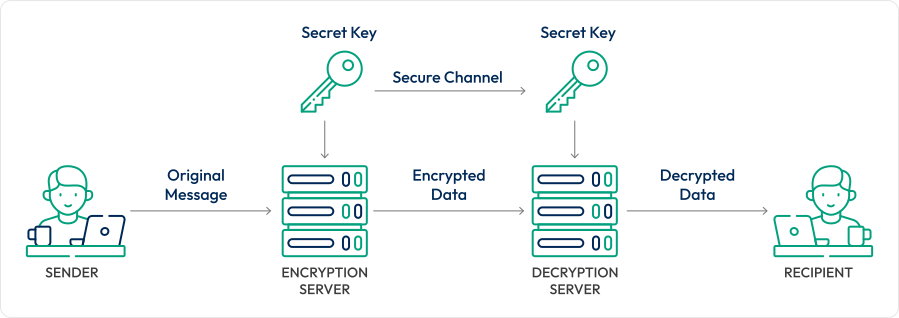
In AES, only one common security key is utilized in the encryption and decryption processes. This implies that the sender and receiver of the information should have the same copy of the secret key.
AES is a block cipher in which the data is not processed in the form of a continuous stream of bits. It splits the plaintext into 128-bit blocks instead.
The encryption process occurs in the following way,
- The secret key undergoes a key algorithmic process called a key schedule in order to come up with a few distinct round keys.
- The initial 128-bit block of data is added with the first round key to bind the data in security key.
- Information is subjected to a series of scrambling operations, such as replacement, mixing, and shifting. The resulting data is given a security key.
During the final round, all the actions of the flow, like substitution, shifting, and key addition, are performed except the mixing to form a ciphertext.
Key Sizes and Their Role in AES
AES-256 is the protocol used in the industry to ensure that data is well protected when it is at rest or in transit. Nevertheless, the size of the security key length covered by this standard is not limited to AES-256 only. It also supports key sizes of 128 and 192 bits.
- AES-128: The most efficient and fastest version, requiring the least computational power.
- AES-192: A middle-ground option for speed and security.
- AES-256: Commonly used by high-security platforms, especially when long-term confidentiality is needed for compliance regulations.
It is, however, a misconception with businesses that the longer the key, the greater the protection. This is not so because key length is not the only parameter that you should examine. As an example, larger keys take a higher number of rounds of data scrambling, resulting in a slower and higher latency performance.
Why AES Remains a Trusted Encryption Standard?
AES, particularly AES-256, provides robust protection in enterprise-grade environments. Its widespread adoption is largely driven by its strong resistance to brute-force attacks. From a practical standpoint, attempting to crack AES using classical computing methods is considered infeasible.
- A 256-bit key space creates an enormous number of possible combinations, making brute-force attacks computationally unrealistic.
- AES-256 is also often described as quantum-resistant in the sense that known quantum attacks do not currently make breaking it practical, especially when compared to classical cryptographic standards.
Beyond its mathematical strength, AES derives trust from its transparent selection process. It was standardized by NIST following a multi-year public evaluation, which makes it one of the most scrutinized and widely trusted encryption standards. As a result, AES is commonly used as a core encryption component in business security architectures aligned with SOC 2 Type 2, ISO 27001, and HIPAA requirements.
Applications of AES in Modern Security Systems
AES is versatile, fast, and efficient, and is one of the major cryptographic standard driving the systems most individuals engage with daily.
-
File and Disk Encryption
AES protects the data stored on the physical media to be secured; it can secure a single document or even an entire storage volume. This makes sure that if a laptop, USB drive, or external hard disk is lost or stolen, the encrypted data remains unreadable to unauthorized users.
-
Security of Devices and Operating Systems
Almost all contemporary operating systems use AES to offer automatic system-level protection against both desktop and mobile operating systems.
-
Wireless Network Security
Wireless data is more susceptible to interception by anybody in range because it is transmitted via the airwaves. AES offers the confidentiality needed to protect such data and is essential in the current Wi-Fi standards.
-
Secure Communications
AES is applied to a large range of streams of communication, such as emails, instant messages, and voice or video information. In such systems, it is AES that has the duty of safeguarding the content of the communication, instead of checking the identity of the sender.
-
Virtual Private Networks (VPNs)
VPNs use AES in order to provide a secure tunnel to pass through public networks. In theory, such tunneling obscures the path that the data takes, so it can be sent through the open internet and retain the same privacy as it has on a closed, internal network.
-
Databases and Application Data
Applications use AES to protect personal, financial, or business-critical information stored in central databases. This is an application-level security that will make sure that access is highly restricted, and the information will be encrypted.
AES vs Other Types of Encryption
The greatest difference in current security architectures lies in the asymmetric and symmetric encryption (AES).
- Symmetric Encryption (AES): This employs a single shared common secret key to encrypt and decrypt. It is performance-oriented and should be used when necessary to encrypt a large quantity of data.
- Asymmetric Encryption: It involves two keys (public and private). Although it is very secure, it is slower and more computationally intensive than AES, which means that it cannot be used to encrypt large files.
The two types are normally grouped together in practice. Modern security architecture involves the use of an asymmetric cipher to guarantee the secure exchange of a secret key between two parties who have never met. After obtaining such a secret key, AES is enabled to do the actual bulk encryption of the data to enjoy the advantages of high security and performance.
When AES is the Right Choice?
AES would be the right option in a situation where there is a need to secure large volumes of data with efficiency and speed. It is specifically good when the needs are high-throughput, such as cloud storage, real-time communication, and full-disk encryption.
The performance considerations of the use of AES can be relatively insignificant on modern systems since, on most processors, there is dedicated hardware acceleration that performs the steps of the encryption process directly in processor hardware.
Conclusion
The AES is the standard of symmetric-key encryption, safeguarding any data, including the top-secret state intelligence, from common web traffic. It was developed to provide enhanced security and improved performance and was standardized in 2001 by NIST.
Nowadays, it is considered a cornerstone of cybersecurity, where governments and industries across the world rely on its established mathematical capability to be efficient in hardware and software, and its capability to scale to current digital systems.
AES Encryption Secures Data & SSL Makes It Trustworthy
AES defines how data is encrypted, but secure communication depends on how that encryption is applied across networks. SSL/TLS certificates implement AES correctly in transit, combining strong encryption with authentication to protect sensitive information from interception.
Related Post: