
 USD
USD  USD
USD  GBP
GBP  EUR
EUR  INR
INR  ZAR
ZAR  AUD
AUD  CAD
CAD  MYR
MYR  SGD
SGD  THB
THB  HKD
HKD  BRL
BRL  AED
AED 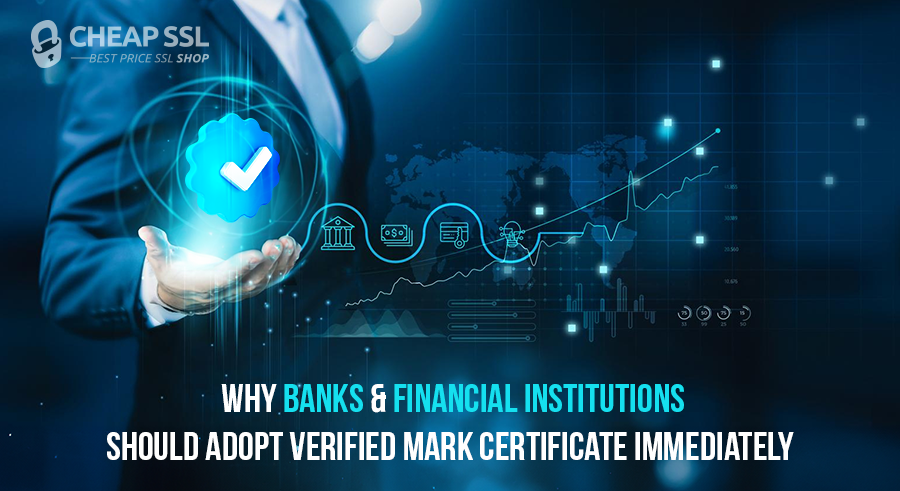
Emails are one of the most critical channels connecting with their customers. Financial institutions use emails to send transaction alerts, credit updates, and loan approvals. And yet many banking institutions face fraudulent communication.
With online banking adoption by customers, banks need to showcase digital authenticity. Plus, banks need to protect customer’s data against advanced phishing, business email compromise (BEC), spoofing, and business impersonation attacks.
This is where a Verified Mark Certificate (VMC) makes a real difference. It authenticates brand identity at a technical and psychological level. Plus, it restores the customer’s confidence in your brand. In this article, we will discuss why email trust is critical for banks and financial institutions and why VMCs are important.
Why Email Trust is a Critical Security Issue for Banks and Financial Institutions Today?
Any business in the current dynamic market needs secure communication with its customers. A spoofed email can lead to loss of trust, account takeover, regulatory fines, and brand reputation. Especially if you are a financial business or institution, your brand is already a primary target for email-based attacks.
Financial institutions need to secure data like credentials, personal identity information, and direct access to capital. If not secured, it can lead to economic losses for the customers and impact brand reputation. This is where a Verified Mark Certificate for financial institutions becomes so crucial. This is also essential because most customers trust their banks to secure against frauds, phishing scams and cyberattacks.
When a customer receives an email claiming to be from their bank, they make a split-second judgment on its legitimacy. If that judgment is wrong, the financial loss can be catastrophic. This is where a VMC serves as a trust indicator to verify the legitimacy of your email.
Phishing and Brand Impersonation as Systemic Banking Risks
Cyber attackers often exploit the association customers have with banks. Using high-resolution logos that resemble those of the brand, colors, and professional layouts, they mimic the brand identity. Because conventional email clients display a blank avatar or an initial beside sender names, customers lack a clear visual indicator to distinguish genuine messages from fakes.
While spam filters and secure email gateways mitigate some malicious traffic, they address only the technical side of security. The trust deficit remains unresolved at the user interface level. As long as emails from a legitimate bank appear visually indistinguishable from fraudulent ones, attackers will continue to exploit human judgment rather than system vulnerabilities.
What a Verified Mark Certificate Actually Solves
A Verified Mark Certificate acts as a digital credential that allows a verified trademark logo to appear directly in the customer’s inbox. Enabled through the BIMI (Brand Indicators for Message Identification) standard, a VMC ensures that a trusted certificate authority has independently verified the displayed logo.
For financial institutions, it functions as a digital passport proof that the sender’s identity has undergone rigorous validation and that the email complies with DMARC authentication standards. In doing so, it translates complex technical protocols into a single, instantly recognizable trust signal. The verified logo tells users, without any technical understanding, that the email is authentic and safe to engage with.
Visual Brand Verification in the Inbox
The true strength of a VMC lies in visibility. In a crowded inbox, an authenticated logo beside the bank’s name stands out immediately. It reinforces the idea that the email is genuinely from your bank.
Without this verification, even legitimate emails blend into a sea of uncertainty, often ignored by wary recipients. Moreover, fraudsters can mimic display names but cannot replicate the verified visual badge associated with a VMC. Over time, customers begin to associate the presence of that logo with trust, effectively conditioning them to spot deception before it succeeds.
Limitations of Traditional Email Authentication Without VMC
Most financial institutions already deploy SPF, DKIM, and DMARC, the technical trio underpinning secure email infrastructure.
- SPF (Sender Policy Framework) defines authorized mail servers.
- DKIM (DomainKeys Identified Mail) ensures message integrity through digital signatures.
- DMARC (Domain-based Message Authentication, Reporting & Conformance) directs receiving servers on how to handle authentication failures.
Although indispensable, these protocols are invisible to end users. A customer cannot discern whether an email has passed DMARC validation. VMC bridges this perception gap, it turns backend security protocols into a visible trust asset. In essence, it rewards a secure configuration with user-facing proof of legitimacy.
Why “Immediate” Adoption Matters for Banks and Financial Institutions
VMC certificates are no longer optional; they are rapidly becoming integral to trust-based communication in the financial sector. Delaying adoption leaves institutions and customers exposed.
- Competitive Advantage and Brand Resilience: Organizations that adopt security measures early signal a higher level of security maturity and leadership. Meanwhile, brands that delay adoption risk appearing outdated or unconcerned about protecting customers.
- Advancing Threat Sophistication: AI powered phishing scams perform hyper-personalized attacks in automated fashion. An authenticated visual signature provides a trust signal that cannot be replicated by machines.
- Regulatory Readiness: With regulators driving towards identity-based approaches to compliance, the adoption of early VMC is an indicator of proactive regulation, and it lowers compliance overhead.
Customer Expectations and Inbox Behavior Are Already Changing
Customers today navigate a digital world defined by visual authentication. Verified icons on social platforms, blue ticks, and padlock symbols on websites all signal safety. The inbox is fast becoming part of this visual language.
When a customer sees a verified logo from a retail brand but a blank icon beside their bank’s name, doubt creeps in. That subconscious hesitation can quickly undermine engagement and brand trust. For younger, digitally native customers, the absence of visual identity verification is gradually becoming a red flag.
Key Prerequisites and Readiness Considerations Before Adoption
The process of getting a Verified Mark Certificate is a multifunctional task, which needs coordination between IT, legal, and marketing departments. Prior to being issued, a number of conditions need to be satisfied by the institutions:
- DMARC Enforcement: A policy set to p=quarantine or p=reject will provide maximum protection against spoof mail.
- Registering a Trademark: Your logo must be registered trademarked with a recognized authority (e.g., USPTO) to verify brand ownership.
- SVG Tiny 1.2 Logo Format: The logo should conform to this safe standardized file format in order to ensure that the logo is rendered in the same way by all clients.
These prerequisites collectively protect the credibility of the VMC ecosystem and keep it exclusive to legitimate organizations with verifiable brand identities.
Conclusion
The inbox has become the frontline of financial cybersecurity. In this zero-trust environment, secure delivery is no longer enough; banks must prove authenticity with every communication.
A Verified Mark Certificate unites the technical rigor of DMARC with the clarity of brand visibility. It transforms backend compliance into front-end trust, protecting customers while reinforcing institutional reputation.
As digital threats evolve, the cost of inaction only escalates. For banks and financial institutions, adopting VMC today isn’t just a technology upgrade. It’s a declaration of accountability, security, and trust in the digital era.
Banks Are Prime Targets for Phishing and Brand Impersonation
A Verified Mark Certificate (VMC) displays your verified trademark logo directly in the inbox, helping customers instantly recognize authentic bank communication.
Related Posts: