
 USD
USD  USD
USD  GBP
GBP  EUR
EUR  INR
INR  ZAR
ZAR  AUD
AUD  CAD
CAD  MYR
MYR  SGD
SGD  THB
THB  HKD
HKD  BRL
BRL  AED
AED 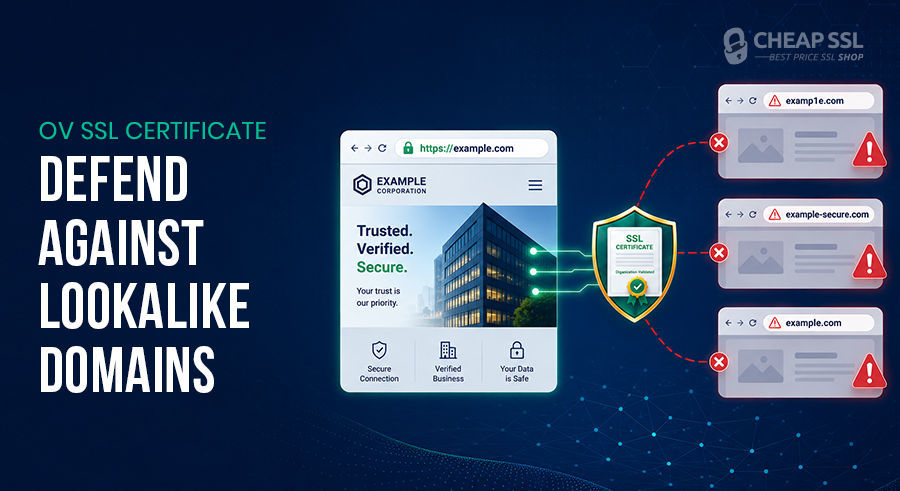
An OV SSL Certificate proves that your website belongs to a verified, legally registered business — by embedding CA-checked organization details directly into the certificate itself, something a phishing clone cannot legitimately replicate under your name.
Lookalike domains can copy your design, your login page, even your domain’s visual structure, but the one thing they cannot obtain is a certificate tied to your actual organization, because that verification is checked against real business registration records before any certificate gets issued.
This article covers how that verification works, what it does and doesn’t protect against, and where OV SSL fits into a broader brand protection strategy.
What Makes a Lookalike Domain Dangerous for Your Brand?
A lookalike domain works because it feels close enough to the real domain when a user is trying to determine which is the legitimate one in seconds. There are a few common ways in which closeness is expressed.
Take an example of a typosquatting swap or drop letters in a known domain. Homograph attacks use characters that look nearly identical to trusted brand letters. Subdomain spoofing pushes the real brand name into a misleading string, such as secure-yourbrand.com, and hopes the visitor reads only the familiar part.
The damage is not limited to the user who enters a password or payment details. A convincing fake site borrows your brand equity, abuses it, then leaves your company answering for confusion it did not create. Support teams end up handling the cleanup, and the trust damage tends to outlast the incident itself.
The core problem is identity ambiguity — a domain can look familiar, a page can copy your login screen, and even browser signals have become unreliable guides. The padlock tells a visitor the connection is encrypted, but it says nothing about who owns the site on the other end. Major browsers have actually moved away from treating it as a trust signal altogether; Chrome replaced it with a tune icon in 2023 and Firefox introduced a grey shield, both moving away from a symbol that was leading users to assume a site was trustworthy rather than simply encrypted.
Encryption and identity are different things, and the distinction matters more than most visitors realize. What separates your real domain from a well-made copy is not whether a certificate exists, it’s what that certificate has been verified to say about the organization behind it.
How OV SSL Closes the Identity Gap Lookalike Domains Exploit
An OV SSL certificate closes that gap by proving something a domain certificate never attempts to establish: that a real, named organization stands behind the site, not merely someone who happens to own the domain.
Before issuing one, the Certificate Authority verifies the applicant’s registered business name, physical address, operational status, and a working telephone contact against independent records. This is where a lookalike operator feels trouble; they can register a similar name, host a polished clone, and even request encryption for that fake domain without much trouble. What they cannot do is pass organizational validation as legal entity.
That single barrier is the protection OV SSL was built to provide. Encryption alone was never enough for brands that need a stronger identity signal, and this is the signal that helps customers, partners, and security teams tell your legitimate domain apart from a convincing imitation.
What Gets Embedded in an OV Certificate That Lookalike Domains Cannot Replicate
An OV certificate carries verified organization details in the certificate Subject fields. The most useful fields are Organization, Locality, State, and Country.
These details are not self-declared profile text. They are checked by the CA. If someone inspects your certificate, they can see your legal organization name. On a fake site’s certificate, the organization field will usually be empty or tied to a different entity.
To inspect a certificate in most browsers, click the site information icon in the address bar, then navigate to “More information” or “Certificate details.” The Organization field will either name a verified company or show nothing — which is telling on its own.
OV SSL vs. Lookalike Domain Certificates at a Glance
| Feature | Your OV Secured Domain | Lookalike Domain Certificate |
|---|---|---|
| Organization | Verified legal business name | Blank, unrelated, or different |
| Location fields | Registered business location | Absent or inconsistent |
| Validation basis | CA verified organization identity | Domain control or unrelated identity |
| Trust signal | Domain tied to your company | Encrypted, but not your brand |
| Visible to security tools | Yes — metadata can be evaluated | Organization absent or mismatched |
How Security Tools and Browsers Use These Fields
Certificate identity is also useful beyond the human visitor who knows how to inspect certificate details.
Enterprise mail gateways, endpoint security tools, browser extensions, and security operations platforms evaluate certificate metadata when judging suspicious links. A domain with verified organizational details can be treated differently from a domain with no organizational identity.
Certification Authority Authorization (CAA) DNS records add another useful signal. They let a domain owner specify which certificate authorities are authorized to issue certificates for that domain. CAA does not stop every lookalike attack because attackers control their own domains. But it strengthens governance around your legitimate domain and gives monitoring teams a cleaner certificate baseline.
Together, OV certificate metadata and CAA records give security tooling more signal to distinguish your verified domain from imitations.
How OV SSL Fits into a Broader Brand Protection Strategy
OV SSL verifies your real domain, but it does not stop someone else from registering a similar one and that distinction matters when thinking about where it fits in a protection strategy. It works best as an identity anchor: your OV certificate establishes the verified baseline (this domain belongs to this legal organization), and everything outside that baseline can then be monitored, challenged, or acted on with more confidence because the legitimate domain is clearly defined.
Supporting controls that strengthen the outer layers include:
- Certificate Transparency log monitoring – helps teams detect certificates issued for brand-similar domains early.
- Proactive registration of common typo domains – reduces the easiest impersonation paths.
- Domain monitoring and takedown workflows – create a process for acting when lookalikes appear.
Brand protection usually depends on more than one control working together. OV SSL is the piece that confirms who’s actually behind the site.
Industries Where OV SSL Brand Protection Matters Most
- Financial services feel the risk first because customers are trained to verify identity before sending money, signing in, or sharing account data. A lookalike site can create direct financial loss and a reputational hit.
- SaaS and B2B platforms face a similar problem around login portals. A cloned sign-in page can expose customer data, connected systems, and downstream integrations. Enterprise clients increasingly check certificate identity as part of vendor security reviews, making OV SSL a signal that goes beyond phishing defense into procurement.
- Healthcare organizations carry a different burden. Patients may enter insurance details, personal records, or appointment information into a site they believe is legitimate. Brand impersonation here creates trust damage and regulatory exposure.
- eCommerce brands are obvious targets because checkout pages, refund portals, and account recovery flows are easy to mimic. OV SSL helps reduce ambiguity around the real transaction environment.
- Government adjacent organizations also benefit because public trust depends on verifiable identity signals. When citizens cannot tell which site is official, the brand damage spreads quickly.
OV SSL Certificates Available at CheapSSLShop
The right OV SSL comes down to one practical question: how many domains and subdomains do you need to cover? CheapSSLShop carries OV certificates from Sectigo, Comodo, GeoTrust, Thawte, GlobalSign, and DigiCert, so there is an option whether you are securing a single corporate site or a sprawling multi-domain setup.
Which OV certificate fits your setup depends on how your domains are structured — one site, several subdomains, or multiple separate domains. Here’s how the options break down.
Single Domain OV SSL
| Certificate | Warranty | Price |
|---|---|---|
| EssentialSSL OV Certificate | $250,000 | $25.00/yr |
| Comodo OV SSL Certificate | $1,000,000 | $34.00/yr |
| Sectigo OV SSL Certificate | $1,000,000 | $34.00/yr |
| Thawte SSL Webserver OV Certificate | $1,250,000 | $75.00/yr |
| GeoTrust True BusinessID Certificate | $1,250,000 | $77.00/yr |
| GlobalSign OV SSL Certificate | $1,250,000 | $180.00/yr |
| DigiCert Secure Site SSL Certificate | $1,750,000 | $425.00/yr |
| DigiCert Secure Site Pro SSL Certificate | $2,000,000 | $1000.00/yr |
Multi-Domain OV SSL
| Certificate | Warranty | Price |
|---|---|---|
| Sectigo OV Multi-Domain SSL Certificate | $1,000,000 | $90.00/yr |
| Sectigo OV Multi-Domain Wildcard SSL Certificate | $1,000,000 | $210.00/yr |
| GeoTrust TBID Multi Domain SSL Certificate | $1,250,000 | $300.00/yr |
Wildcard OV SSL
| Certificate | Warranty | Price |
|---|---|---|
| EssentialSSL OV Wildcard Certificate | $250,000 | $90.00/yr |
| Sectigo OV Wildcard SSL Certificate | $1,000,000 | $206.00/yr |
| Sectigo OV Multi-Domain Wildcard SSL Certificate | $1,000,000 | $210.00/yr |
| Thawte SSL Webserver Wildcard OV Certificate | $1,250,000 | $270.00/yr |
| GeoTrust TBID OV Wildcard SSL Certificate | $1,250,000 | $300.00/yr |
View the full range of OV SSL Certificates available from leading certificate authorities.
Conclusion
OV SSL will not erase lookalike phishing domains by itself; that is not its for. Its value is more specific: it proves which domain is genuinely tied to your organization. In a threat landscape where fake sites can look polished, carry encryption, verified identity becomes the signal that holds; your customers, partners, and security tools can trust before damage starts, even when the page already feels familiar.
Frequently Asked Questions
Can a lookalike domain get an OV SSL certificate?
Yes, if the attacker can register a real, legally registered business and pass the CA’s verification process. What they can’t get is a certificate showing your organization’s name. The certificate will reflect their identity, not yours, so anyone who checks it will see a mismatch.
How do I check if a site has an OV certificate?
Click the icon left of the URL in your browser, then open “Certificate” or “More information.” Look at the Subject section — an OV certificate shows an Organization field with a verified business name. A DV certificate shows only the domain, with nothing in that field.
Is OV SSL enough to stop phishing?
No. An OV certificate proves the site belongs to a legitimate, verified business, but it doesn’t stop someone from hosting a phishing page on their own domain or a hacked subdomain. It’s one signal in a layered defense.
What is the difference between OV and EV SSL certificates?
Both verify organizational identity, but EV goes through a stricter vetting process and historically displayed extra trust indicators in the browser, most of which have since been removed. The real difference today comes down to how thorough the vetting is and what business details get verified.
Attackers can copy your branding, but they cannot verify your business identity. An OV SSL Certificate provides CA-verified organizational identity that helps distinguish your legitimate website from lookalike domains.