
 USD
USD  USD
USD  GBP
GBP  EUR
EUR  INR
INR  ZAR
ZAR  AUD
AUD  CAD
CAD  MYR
MYR  SGD
SGD  THB
THB  HKD
HKD  BRL
BRL  AED
AED 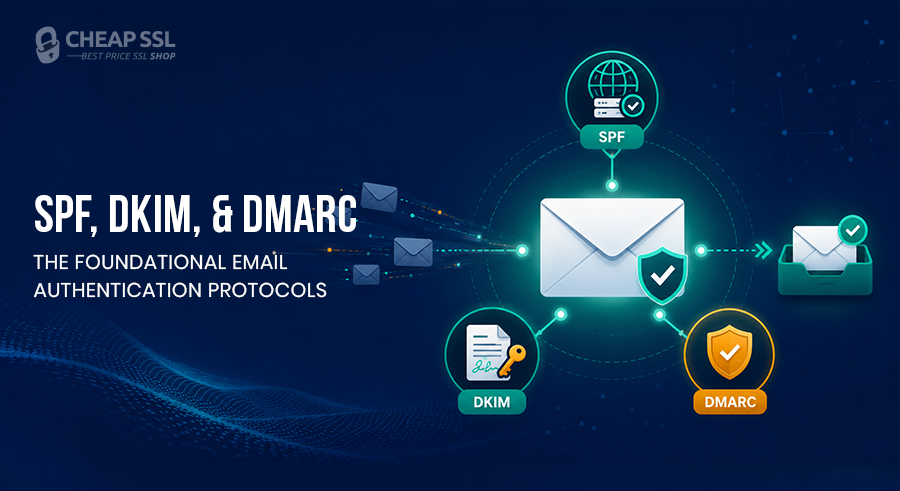
Email security is not something that is achieved in a single step. Each email you send passes through multiple checkpoints, and attackers only need one of those to be missing.
A domain can have SPF configured and still be spoofed in ways the recipient barely notices. A message can carry a valid DKIM signature and still fail to prove the visible sender identity. These are the normal failure modes of single-layer authentication. The gap exists because each protocol solves a different piece of the problem.
You need all three. A partial setup does not provide full protection, and that is what attackers depend on.
SPF as the First Layer of Sender Validation
Sender Policy Framework – SPF is a DNS-based email authentication method that specifies which IP addresses and mail servers are authorized to send email on behalf of your domain. When a receiving server gets an email, it checks the return-path domain against the SPF record published in DNS and either passes or fails the message based on whether the sending IP is listed.
How SPF Works in Real Email Flows
SPF relies on DNS (Domain Name System). The owner of the domain publishes the list of acceptable mailers in the form of a TXT record or third-party applications allowed to send emails in their name.
Once an email arrives, the receiving server examines the domain of the return path, finds the SPF record for it, and then matches the sender’s IP address with the content of this record. If the IP is authorized, SPF passes.
Understanding the SPF all mechanism, this matters more than most people realize:
- -all (hard fail): reject mail from unauthorized sources. Recommended once your record is stable.
- ~all (soft fail): mark as suspicious but deliver anyway. Common during testing and migration.
- +all (open relay): accept mail from any source. Never use this. It defeats the purpose of SPF entirely.
Where SPF Adds Value
SPF is very helpful at blocking unauthorized hosts from sending messages pretending that these emails were sent from your network. Hence, SPF becomes a good choice for email validation. It is also widely supported. Most mailbox providers and receiving systems know how to evaluate SPF, which is one reason it remains foundational.
SPF’s Scope: Sending Authorization Only
SPF does not validate the visible sender identity that a user sees in the ‘From’ field. It checks the return-path, which is a behind-the-scenes address used for bounce handling. That creates room for abuse.
Forwarding is where SPF’s path-based design shows its boundaries. A forwarded email may fail SPF even when the original sender was legitimate, because the forwarding server was not listed in the original SPF record. This is one reason DKIM exists.
DKIM as the Layer That Protects Message Integrity
DomainKeys Identified Mail – DKIM is an email authentication standard that uses cryptographic signatures to verify that the content of the message and key headers were not altered after it left the sending server, and that it was sent by a server authorized to use the signing domain.
How DKIM Verifies Email Authenticity
When a message is sent, the outgoing mail server generates a digital signature using a private key held securely by the domain owner. That signature is added to the message and covers specific fields, typically From, Subject, Date, To, and the message body.
The receiving server then retrieves the public key from the sending domain’s DNS, stored as a TXT record under a selector subdomain.
It uses that public key to verify the signature. If the headers or body have been modified in transit, the signature won’t match and DKIM fails. If everything checks out, DKIM passes and the receiving server has cryptographic proof that the message arrived intact.
What DKIM Secures That SPF Cannot
DKIM protects the content and structure of the message in a way SPF does not. If the email body or signed headers are modified in transit, the signature breaks.
It also survives some delivery scenarios better than SPF. A forwarded message may still pass DKIM because the signature stays attached, even when the sending path changes. This gives receiving servers a stronger trust signal.
How DKIM Works Alongside the Protocols Around It
Key management is the main operational side of DKIM. Keys need to be generated correctly, published under the right selector, and rotated periodically. A key that hasn’t been touched in years is worth auditing.
Some intermediaries, mailing list managers especially, rewrite Subject lines or append footers to the message body. Since DKIM signs those elements, any modification after signing means the receiving server sees a signature that no longer matches. This is expected behavior, not a flaw in DKIM itself. It’s just worth keeping in mind when you’re troubleshooting delivery.
On its own, DKIM has no enforcement mechanism — a failed check doesn’t mean the message gets blocked. Deciding what happens next is where DMARC picks up.
DMARC as the Policy and Control Layer
Domain-based Message Authentication, Reporting, and Conformance – DMARC is an email authentication policy that uses SPF and DKIM results to determine whether an email’s authenticated domain aligns with the domain the recipient sees in the ‘From’ header and specifies what receiving servers should do if it doesn’t.
How DMARC Connects SPF and DKIM
DMARC uses the results of SPF/DKIM checks to determine whether either of those signatures aligns with the visible sender (domain in the ‘From’ field) of an email. This is the essential connection between the two methods that some people forget about.
DMARC Policies and Their Impact
In addition to aligning results from other layers, DMARC also lets domain owners define policies that should be used by the receiving server in case of a failure.
- p=none is the lowest-level policy and means that only data will be collected, but no action or instructions for handling email will be provided.
- p=quarantine is the mid-level and asks to put suspicious email messages in the spam folder.
- p=reject is the highest level of the DMARC policy that tells receiving servers to completely block suspicious emails.
This is what makes DMARC more than a reporting mechanism, and it controls the process.
The Role of Reporting and Visibility
Using the DMARC reporting feature, companies can monitor which domains send mail on their behalf and find out if there are any failures during authentication checks. The importance of reporting becomes clear when companies realize that they might have more sources of emails than they expect.
Having DMARC reporting allows seeing which sources are legitimate, which are not, and gradually tightening the policy settings until there are no false positives left.
How SPF, DKIM, and DMARC Work Together in a Real Email Flow
Here’s what really happens to the email message.
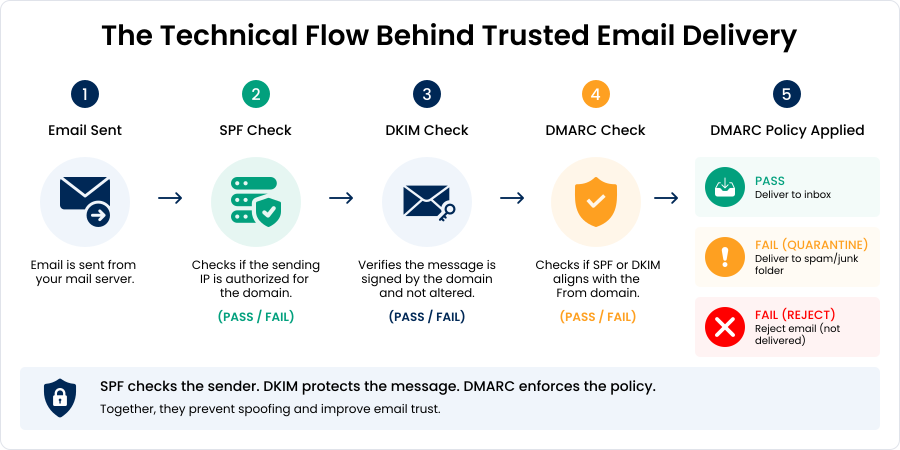
- First, it goes through the sender’s server and reaches the destination. Then, the receiving server checks whether the sending IP is authorized with respect to the return path domain.
- Second, it checks if the message is signed by the authorized domain name and whether it passed verification.
- Finally, DMARC analyzes SPF and DKIM checks and asks the question: Does the domain align with the domain in the ‘From’ field?
If alignment exists and authentication passes, the message has a much better chance of being trusted and delivered normally.
Business Impact of Proper Email Authentication
A proper email authentication enhances the organization’s security posture. First of all, it improves deliverability as a well-known domain is more reliable than an inconsistent one for mailbox providers. It lowers the risks of phishing and impersonation, including exact-domain spoofing, which can damage the relationship with customers almost instantly.
At the same time, a secure domain improves its reputation over time. This way, the organization will benefit from increased inbox rates, better results in any marketing campaigns, and improved delivery of operational emails such as invoices, password reset requests, and account notifications.
Implementing DMARC means getting better insight into your own email ecosystem, which can be surprisingly complicated in practice.
Common Mistakes That Weaken Email Authentication
- Incomplete SPF configuration- If approved senders are missing, legitimate mail can fail. If old services stay in the record forever, the surface area stays larger than it should.
- Inconsistent DKIM coverage- Some organizations enable it on one platform and forget the others. That leaves obvious holes.
- DMARC monitoring mode for too long- Monitoring has a purpose, but it is not the end state. If a domain never moves beyond p=none, it gains visibility without real enforcement.
- Domain Misalignment- SPF or DKIM may pass, but if the authenticated domain does not align with the visible ‘From’ domain, DMARC may still fail. Then there is simple neglect.
The Future of Email Authentication and Brand Trust
Mailbox providers are moving toward stricter enforcement. The 2024 requirements from Google and Yahoo were the most visible enforcement step, but the underlying trend has been building for years. Domains that cannot prove their identity through authentication are increasingly treated as suspect, regardless of their content.
Domain alignment is becoming more important because identity in email matters more than it used to. It’s no longer enough for a message to look legitimate. Providers want technical proof, and the bar for what counts as proof keeps rising.
BIMI (Brand Indicators for Message Identification) is the clearest signal of where this is going. BIMI lets domain owners display their brand logo directly in the inbox — in the sender avatar slot — for recipients at supported providers, including Gmail, Yahoo, and Apple Mail. It’s a visible trust signal that works at the inbox level.
But BIMI has a hard requirement; your domain must have a DMARC policy of quarantine or reject. For displaying the logo, you also need a Verified Mark Certificate, issued by a Certificate Authority that verifies your legal right to use the trademarked logo.
The connection between authentication, policy enforcement, and brand visibility is direct. The infrastructure you build for email authentication is the same infrastructure that unlocks these trust signals.
Conclusion
Today, SPF, DKIM, and DMARC cannot be considered as an option. These protocols serve as critical layers ensuring the trust between organizations and customers.
The setup process is sequential: get SPF working first, then configure DKIM on every sending platform, then publish a DMARC record at p=none and use the aggregate reports to validate your coverage. Once your reports are clean, move to enforcement. The process takes time to do correctly, but the protection it provides and the deliverability it supports make it worth the investment.
Email Trust Starts with Authentication. Make It Visible in the Inbox.
SPF, DKIM, and DMARC prove your domain is legitimate. A VMC or CMC puts that trust where recipients can actually see it — your verified brand logo, right in the inbox.
Related Posts: