
 USD
USD  USD
USD  GBP
GBP  EUR
EUR  INR
INR  ZAR
ZAR  AUD
AUD  CAD
CAD  MYR
MYR  SGD
SGD  THB
THB  HKD
HKD  BRL
BRL  AED
AED 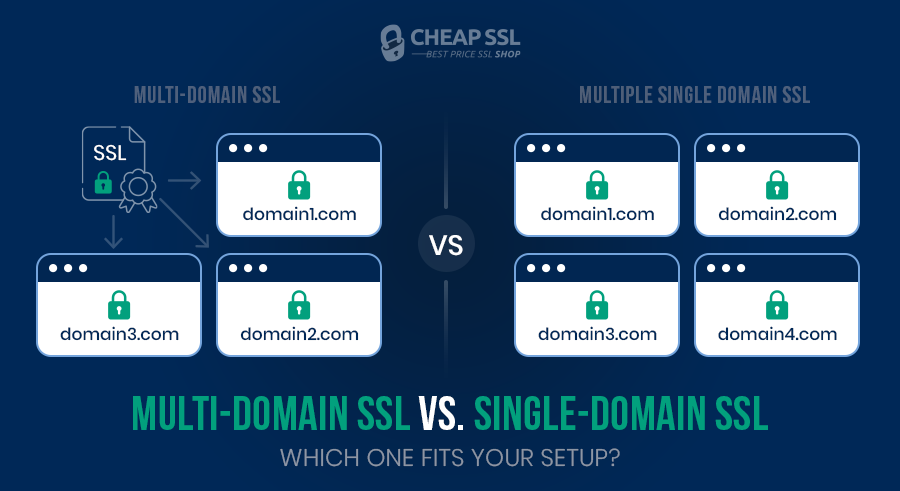
Managing SSL certificates across multiple domains is an operational and financial decision. Every domain you add either goes on an existing certificate or triggers a new purchase, a new validation cycle, and another expiry date to track.
This guide breaks down the actual cost difference between multi-domain SSL certificates and running multiple single-domain certificates – covering direct pricing, management overhead, and security risk, so you can make the right call for your infrastructure without overcomplicating it.
What is a Multi-Domain SSL Certificate?
A multi-domain SSL certificate secures many domains and sub-domains under a single certificate with the use of Subject Alternative Names, also known as SANs. This implies that a single certificate can be used to secure multiple company domains, such as company.com, company.net, company.org, and subdomains such as shop.company.com or blog.company.com.
It is also referred to as a UCC SSL certificate. You put it on a single server and have a single validation process that encompasses all domains included. Some of the key types of multi-domain certificates are Domain Validation, Organization Validation, and Extended Validation certificates.
What are Multiple Single-Domain SSL Certificates?
Single-domain certificate only secures a single domain at a time, both with and without the www prefix. You purchase, install, and renew five different certificates in case you have five domains. The validation levels are same: DV, OV, and EV.
Certain CA services have volume pricing, and therefore, the per-certificate price may be reduced when you purchase a large number of certificates. However, you are still handling each cert separately.
Multi-Domain SSL vs. Single-Domain SSL: Side-by-Side Comparison
| Factor | Multi-Domain SSL | Single-Domain SSL |
|---|---|---|
| Certificate count | One cert for all domain | One cert per domain |
| Typical cost | $15–$440/year | $3.99–$1300/year combined |
| Bulk discount potential | Built-in by design | Possible with volume pricing |
| Renewal management | Single renewal cycle | Multiple expiry dates to track |
| Adding a new domain | Reissue required (affects all) | Buy one new cert only |
| Private key exposure | Shared key – wider blast radius | Isolated per domain |
| Compromise impact | All domains affected | One domain affected |
| SNI compatibility | Full support | Full support |
| Best for | Stable domain sets | Changing or isolated portfolios |
| Automation friendliness | Simpler (one object) | Better with CLM tools |
Multi-Domain SSL vs Multiple Single-Domain SSL Direct Cost Comparison
On the surface, the multi-domain option looks like a clear win.
One certificate instead of many. One checkout instead of repeating the same process across five or ten domains every year.
But the price difference is not always simple. Single-domain certificates can compete on cost when:
- You qualify for bulk pricing
- You use low-cost DV certificates
- You automate purchasing and renewal
Some teams drive their single-domain cost down enough that it rivals the multi-domain price. That does not remove the complexity, but it can soften the budget impact.
Hidden costs are where the comparison shifts:
- Time spent installing, validating, and renewing multiple certificates
- Risk-related costs if a cert expires or needs emergency reissuance
- Downtime and incident impact when something breaks
When you get multi-domain SSL certificate, you often win on direct cost, but single-domain certificates can stay competitive when discounts and automation are in play.
Management Costs and Operational Effort
The real cost is not only what you pay. It is the operational effort you spend to keep everything running. That is where the gap shows up.
Multi-Domain SSL: Operational Simplicity
You run one renewal cycle for every domain covered by the certificate. One validation process. One installation. That trims workload quickly, especially if you are a small team without dedicated certificate tooling.
This matters because it reduces routine work. No calendar juggling. No five different expiration dates. Fewer chances to miss something.
Multi-Domain SSL: Limitations
The trade-off is control and flexibility. If you add or remove a domain, the certificate needs to be reissued. All covered domains are tied to the same lifecycle. One certificate decision affects everything. That is fine when your domain set is stable. It is a headache when it is not.
Single-Domain SSL: Operational Flexibility
Each domain stands on its own. You can replace or renew one certificate without touching the others. If you use Certificate Lifecycle Management tools, this setup can run efficiently.
- Automated renewals
- Easier tracking across a large fleet
- Clear separation between domains
Server Name Indication (SNI) makes it technically straightforward to host multiple single-domain SSL certificates on a single server/IP address, which reduces the operational advantage of Multi-Domain SSL. Multi-domain reduces routine management effort, while single domain offers more flexibility at scale. The right choice depends on how stable and how automated your environment is.
Single Domain SSL Operational Limitations
Drift shows up as the domain count grows. Certificates end up with different validation levels, renewal windows, and deployment paths. Nothing breaks, but nothing stays consistent.
Keeping them aligned takes active control. At scale, that usually means tooling. Without it, gaps creep in – missed renewals, mismatched configs, uneven setups across environments.
Risk & Security Impact of Multi-Domain and Single-Domain SSL
Security risk exists whether you track it or not. SSL is not only about encryption. It is also about how failure spreads.
Multi-Domain SSL: Centralized Risk
A single private key secures all covered domains. If that key is compromised, every domain on that certificate is exposed. One issue becomes many. That is a real centralized point of failure, and it is worth taking seriously when you are putting multiple business-critical domains on the same certificate. It also increases the blast radius of access-related mistakes. Anyone with that key has influence over every site on the certificate. That is not always acceptable.
Single-Domain SSL: Isolated Risk
Each domain has its own certificate and private key. If one is compromised, the others are not. You can revoke or reissue a single certificate without affecting the rest. Single-domain SSL spreads risk across domains, which can be safer when you need isolation.
Which Scenario Fits Which Certificate Type?
Choosing between multi-domain SSL and multiple single-domain certificates needs a clear framework. And this depends on a specific use case, so you should choose the most suitable certificate based on business needs.
Multi-Domain SSL is the better choice when:
- You manage multiple stable domains or subdomains.
- You want fewer certificates to track.
- Your team prefers centralized control.
- You need to secure related properties quickly.
Best Multi-Domain SSL Certificate Options
| Product Name | Validation Type | Price |
|---|---|---|
| PositiveSSL DV Multi-Domain Certificate | Domain Validation | $15.00/yr |
| PositiveSSL DV Multi-Domain Wildcard Certificate | Domain Validation | $80.00/yr |
| PositiveSSL EV Multi-Domain Certificate | Extended Validation | $135.00/yr |
| Sectigo DV Multi-Domain SSL Certificate | Domain Validation | $80.00/yr |
| Sectigo OV Multi-Domain SSL Certificate | Organization Validation | $90.00/yr |
| Sectigo EV Multi-Domain SSL Certificate | Extended Validation | $190.00/yr |
| GeoTrust TBID Multi Domain SSL Certificate | Organization Validation | $300.00/yr |
| GeoTrust TBID EV Multi Domain SSL Certificate | Extended Validation | $440.00/yr |
Multiple Single-Domain Certificates are the better choice when:
- Your domain portfolio changes frequently.
- You benefit from volume pricing.
- You use or plan to use automation tools, such as CLM.
- You require a clean separation between domains.
Affordable Single-Domain SSL Certificate Options
| Product Name | Validation Type | Price |
|---|---|---|
| ClickSSL Standard SSL Certificate | Domain Validation | $3.99/yr |
| EssentialSSL DV Certificate | Domain Validation | $5.99/yr |
| PositiveSSL DV Certificate | Domain Validation | $7.99/yr |
| RapidSSL DV certificate | Domain Validation | $14.00/yr |
| EssentialSSL OV Certificate | Organization Validation | $25.00/yr |
| Sectigo DV SSL Certificate | Domain Validation | $25.00/yr |
| Thawte SSL123 DV Certificate | Domain Validation | $32.00/yr |
| Sectigo OV SSL Certificate | Organization Validation | $34.00/yr |
| GeoTrust DV SSL Certificate | Domain Validation | $40.00/yr |
| PositiveSSL EV Certificate | Extended Validation | $50.00/yr |
| Sectigo EV SSL Certificate | Extended Validation | $65.00/yr |
| GlobalSign DV SSL Certificate | Domain Validation | $88.00/yr |
| GlobalSign OV SSL Certificate | Organization Validation | $180.00/yr |
| GlobalSign EV SSL Certificate | Extended Validation | $300.00/yr |
| DigiCert Secure Site SSL Certificate | Organization Validation | $425.00/yr |
| DigiCert Secure Site EV SSL Certificate | Extended Validation | $820.00/yr |
Conclusion
Multi-domain SSL is generally the less complex and less expensive way to go when your domains are stable, and you desire the minimal management overhead. Single-domain certificates will provide you greater control, although the initial appearance cost may be higher if you operate a shifting domain portfolio or desire strong isolation between properties. Not only pricing, but time and risk that you are prepared to bear. Therein, the actual cost difference is reflected.
Multi-Domain or Single-Domain SSL? Make the Right Choice
The way you secure multiple websites affects both cost and management. Choosing the right SSL approach upfront helps you stay efficient, avoid extra overhead, and scale without complications.
Related Posts