
 USD
USD  USD
USD  GBP
GBP  EUR
EUR  INR
INR  ZAR
ZAR  AUD
AUD  CAD
CAD  MYR
MYR  SGD
SGD  THB
THB  HKD
HKD  BRL
BRL  AED
AED 
E-commerce brands lose billions every year to cart abandonment, but not all of that loss happens at checkout. A significant part of it happens in the inbox, in the few seconds where a customer decides whether to open a recovery email at all. eCommerce is one of the most impersonated categories in phishing, and shoppers have adapted. They learned to hesitate on urgent transactional emails, which is exactly the kind brands rely on for recovery. Verified Mark Certificates address that hesitation directly – closing the inbox trust gap that quietly drains e-commerce email performance before a single click happens.
This post breaks down why that matters specifically for e-commerce, what the prerequisites look like, and where the revenue impact actually shows up.
Why E-Commerce Emails Are a Prime Phishing Target
E-commerce businesses have a certain communication pattern. Most of their emails are urgent and transactional. Order confirmations, shipping updates, and payment reminders – these require immediate response. Because of this, attackers find them very appealing.
Phishing campaigns rely on urgency and familiarity. An email that says “Your order has been shipped” or “Complete your purchase before items sell out” doesn’t feel unusual. It feels expected. Attackers don’t need to invent new narratives, they simply mirror what brands are already sending.
This is also why retail and payment-related brands consistently rank among the most impersonated categories. The user behavior is predictable, and the stakes, money, accounts, and personal data are high enough to make it worth the effort.
If a customer receives one convincing phishing email pretending to be your brand, then their trust in your brand is lost. The next time they see a similar subject line, even if it’s legitimate, they hesitate, pause, or sometimes ignore it altogether. That hesitation is where revenue quietly disappears. Email spoofing and impersonation are conversion problems; it breaks trust between you and your customer.
How Inbox Skepticism Stops You from Recovering Abandoned Carts
Inbox hesitation shows up earlier, before the email is even opened. By the time a recovery email lands, the user is already cautious. So, the problem isn’t just cart abandonment. It’s that your recovery channel itself is being filtered through doubt.
Cart Abandonment Rates and the Email Recovery Window
Cart abandonment is already one of the biggest leaks in the e-commerce funnel. The global average sits around 70%. That means nearly three in four potential purchases never get completed.
Email is the primary recovery mechanism for e-commerce brands. Cart abandonment emails consistently perform better than most marketing campaigns because they’re contextual. The user already showed intent. The email just nudges them to finish what they started.
A large portion of users abandon carts because they are not sure about payment safety or the legitimacy of the site. That same distrust does not disappear after they leave. It carries forward into the inbox.
So when a cart recovery email lands, the user isn’t just deciding whether to buy. They’re deciding whether the email itself is safe. If they misclassify it as suspicious, the recovery window closes permanently.
Where the Trust Gap Actually Costs Revenue
The drop-off doesn’t happen randomly. It happens at very specific points in the email funnel.
- The first abandoned cart reminder
- The follow-up re-engagement sequence
- Post-purchase upsell or cross-sell emails
Each of these depends on one simple action, the user opening the email.
A legitimate email and a phishing email can look identical in the inbox if there is no clear trust signal. From the user’s perspective, ignoring such emails is the safest option. This is where the revenue impact becomes measurable.
A simple way to think about it is,
Recovered Revenue = (Abandoned Carts × Open Rate × Conversion Rate × Average Order Value)
Even a small increase in open rate has a direct effect. If you improve opens by 5 percent on a large, abandoned cart volume, that translates into actual orders, not just engagement metrics.
How Verified Mark Certificate Creates a Visual Trust Signal
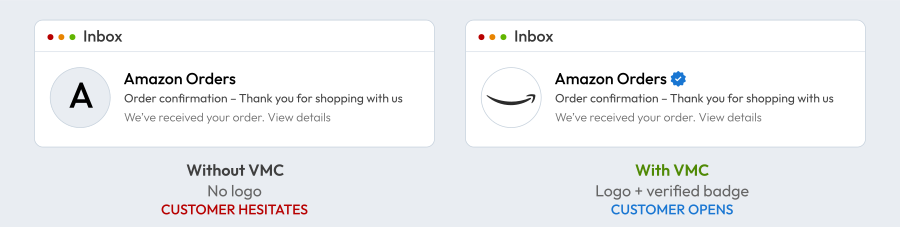
Verified Mark Certificates, often referred to as VMC certificates, introduce something email has historically lacked, a visual identity at the inbox level.
With a VMC in place, your trademarked logo appears next to your sender’s name in the inbox on supported email clients. Once the email is opened, a blue verified checkmark appears beside your sender name, confirming the logo is authenticated, and the email is legitimate.
For an e-commerce user scanning their inbox, this changes the decision-making moment. Instead of relying on sender names or subject lines alone, they see a familiar, verified logo before they click. That recognition happens instantly. It reduces the cognitive effort required to decide whether the email is legitimate.
Without this, a cart reminder from your brand and a phishing attempt imitating your brand can look almost identical. With verified mark certificate, there’s a clear distinction. The presence of a verified logo acts as a shortcut in the user’s mind that this is really them. This small shift has a measurable effect on open rates, brand recall, and ultimately, purchase completion.
Why This Matters More for Transactional Email Than Marketing Email
Promotional emails can tolerate low engagement. If a campaign underperforms, the next one can compensate. Transactional emails don’t have that edge.
A cart recovery email represents a single opportunity tied to a specific user action. If it is not opened, that opportunity doesn’t come back. This is where VMC has a disproportionate impact.
Adding a verified visual element, the email no longer feels ambiguous. It feels official, professional, and expected. Even urgency-based subject lines, like “Your items are almost gone”, stop feeling like potential scams and start reinforcing intent, because the visual identity backs them up.
E-Commerce Specific Prerequisites Before Applying for VMC
Getting a Verified Mark Certificate isn’t complicated, but e-commerce setups have more moving parts than a typical business. Before you apply, there are a few operational realities worth resolving.
Multi-Sender Infrastructure Alignment
Most e-commerce setups are not sending emails from a single system. They typically have:
- A primary email service provider for campaigns.
- A transactional email service for receipts and cart reminders.
- An order management system that generates updates.
- Sometimes, third-party services for shipping notifications.
For VMC to display consistently, every sending source needs to be authenticated under your domain.
The reason this matters technically: BIMI display is tied to the visible ‘From’ domain — the one your customer actually sees in their inbox. Any sending source whose DKIM signature doesn’t align to that domain falls outside BIMI’s scope entirely, regardless of whether the certificate is in place.
Before applying, audit all active sending domains and subdomains. Brands frequently discover legacy tools, dormant integrations, or unauthorized senders during this process, and any unauthenticated stream won’t show the verified logo even after the certificate is issued.
One VMC Per Domain, Per Logo
Each Verified Mark Certificate is tied to a specific base domain and a logo. The certificate doesn’t float across properties.
For example:
- .com and .in domains
- Regional storefronts
- Sub-brands with different logos
Each combination may require its own certificate. The practical upside is that every domain you cover gets the full trust signal independently. Users on every regional storefront see the verified logo, not just the primary one. The coverage is precise rather than assumed. This is often overlooked during initial planning, especially for brands with multi-region operations.
Some certificate authorities do support multiple logos for sub-brands or temporary campaigns, but this needs to be planned in advance. You can’t dynamically swap logos without considering how they’re registered and validated. If your brand runs frequent seasonal variations, this becomes a design and compliance consideration, not just a marketing one.
Measuring the Impact After VMC Deployment
VMC is not just a branding upgrade. It is measurable, and the key metrics to track after deployment include,
- Open rates on transactional and recovery emails
- Click-through rates from those opens
- Conversion rates from email-driven sessions
- Revenue attributed to cart recovery campaigns
Organizations using VMC implementations have reported noticeable improvements in engagement. The exact lift varies, but even small percentage changes matter at scale. Let’s say,
- You have 50,000 abandoned carts per month.
- Your current open rate is 30%
- You improve that to 35%
That’s 2,500 additional users entering your recovery funnel. Apply your existing conversion rate and average order value, and you get a concrete revenue number tied directly to that improvement.
The impact also compounds over time. As users repeatedly see your verified logo in their inbox, it becomes associated with safety and legitimacy. Future emails benefit from that recognition without additional effort. A simple way to confirm this is through A/B testing.
- Segment your audience.
- Send VMC-enabled emails to one group.
- Compare performance against a control group.
Within a few cycles, the difference will become clear.
Is VMC Right for Your E-Commerce Business Right Now
If your brand runs consistent email campaigns and cart recovery is a real revenue channel, VMC fits into that infrastructure directly. Every cart recovery email that gets opened because the logo made it feel safe is a recovered sale that would have otherwise been written off.
There’s also a defensive side worth naming. Brands that get impersonated frequently see long-term deliverability damage as users start marking emails as suspicious. A verified visual identity makes impersonation harder and gives your customers a clear way to distinguish your emails from fakes.
The one honest caveat: trademark registration takes 6 to 18 months. If you don’t have one yet, treat VMC certificate as a forward-looking investment, instead of thinking about it as a quick fix. The brands that get the most out of it start the process early and treat it as part of their permanent email infrastructure.
Conclusion
E-commerce already operates on thin margins when it comes to conversion. Most of the funnel is optimized heavily, from landing pages to checkout flows. The inbox is often overlooked, and that’s where VMC changes the equation. By introducing a verified, visual trust signal at the exact moment a user decides whether to engage, it closes a gap that traditional email optimization doesn’t address. And in a space where a single opened email can recover a lost sale, that gap is worth paying attention to.
Your cart recovery emails are only as effective as the trust behind them. A Verified Mark Certificate puts your trademarked logo in every inbox, turning hesitation into opens and opens into completed orders.
Related Posts: