
 USD
USD  USD
USD  GBP
GBP  EUR
EUR  INR
INR  ZAR
ZAR  AUD
AUD  CAD
CAD  MYR
MYR  SGD
SGD  THB
THB  HKD
HKD  BRL
BRL  AED
AED 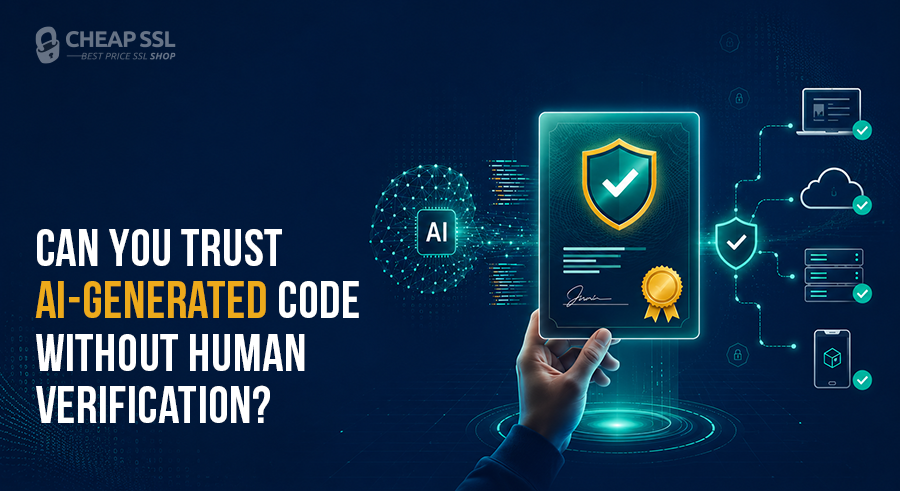
Modern AI-assisted development often goes beyond a developer asking Copilot to autocomplete a function. There is a huge dependence on AI-assisted software development nowadays. This often involves agent-based models that run in repeatable loops. In this environment, AI create, tests, and refines code with little to no human involvement. Human roles have evolved into three categories:
- Those who are “in the loop” (reviewing outputs directly).
- Those who are “on-the-loop” (providing oversight and setting constraints).
- Those who are “out of the loop” (delegating all execution to AIs).
The trend across enterprise teams is firmly toward the second and third categories. Higher volume, tighter release cadences, and developer productivity pressures all push in that direction. It does change the risk profile of everything downstream, including how software is signed and verified.
The Security Problem Hidden Inside AI-Generated Code
AI is outpacing human capabilities in writing code. The problem is that AI output looks trustworthy. Clean syntax, passing tests, no obvious errors. The issues tend to hide deeper. This can be very dangerous, as even AI-generated code sometimes contains errors or security issues. In fact, fixing AI-generated code can take as much time and effort as writing it from scratch.
Three characteristics of AI-generated code make this particularly hard to manage at scale:
- Pattern replication at volume. AI tools learn from training data. When that data contains insecure patterns, the model replicates them consistently, meaning the same flaw can appear across thousands of files rather than one developer’s commit.
- Test-passing code that fails in context. A model optimizing for test passage may produce code that satisfies defined assertions but behaves incorrectly when those assertions don’t cover every edge case.
- Reduced visibility into intent. When a human writes code, reviewers can interrogate their reasoning. With AI output, there is no equivalent reasoning to review.
Many developers use AI on a daily basis, but they can’t fully trust on it. The tools are indispensable. Confidence is not there. That gap is exactly where code signing and human verification become critical.
Why Can’t AI Sign Its Own Code?
This is the question that cuts to the centre of the issue. If an AI system can write code autonomously, why not let it sign that code too?
The answer comes down to how the trust model behind code signing actually works. A code signing certificate is a legal credential. Certificate Authorities issue signing certificates only after verifying a real identity: an individual developer, a registered company, or an organization with a provable legal existence. The CA acts as the trust anchor, and the signed software inherits the CA’s reputation through the chain of trust.
When a human signs a piece of software, they are making an accountability statement. Automated tools can detect issues in source code, like static analysis, SAST scanners, and dependency audits, but they do not validate correctness in context, and they cannot take legal or reputational responsibility for what gets shipped.
If AI were permitted to sign its own outputs, that chain collapses. The non-repudiation guarantee — the ability to trace a signed binary back to an accountable human publisher disappears. There would be no person, no organization, and no legal entity behind the signature. Users and operating systems would have no meaningful way to assess whether the software came from a source they can hold accountable.
This is not a hypothetical risk. Compromised code signing keys are already among the most damaging attack vectors in software supply chain security. Allowing AI to control the signing process would introduce a structural equivalent and a signing pathway with no accountable human behind it.
Human Oversight is Still the Core Control Layer
Human supervision is still required, even if AI has advanced rapidly. It still cannot interpret business context, assess architectural intent, or determine whether code is not just functional but appropriate for the environment it will run in.
In practice, this maps to three distinct responsibilities:
Specification and constraint ownership
Humans define what the code is supposed to do, what it must not do, and what success looks like. This includes writing test specifications, defining security requirements, and establishing architectural boundaries before generation begins.
Validation framework design
Rather than reviewing individual outputs, security-conscious teams are shifting toward maintaining the systems that evaluate outputs at scale; automated security scanning, SAST integration, dependency analysis, and observability tooling that tracks code behavior in production.
Final sign-off before release
Code signing sits at this stage. Before software is signed and distributed, a human reviewer confirms that the validated output meets the organizational, security, and compliance requirements relevant to that release. This is where the distinction between OV and EV code signing certificates becomes relevant. becomes relevant.
From Code Review to Verification Systems
With AI generating code at scale, traditional line-by-line review no longer holds up. The response is a shift toward automated, structured verification pipelines; systems designed to evaluate output consistently rather than inspect it manually.
This is often called a harness-first approach: validation infrastructure is built before code generation begins. That means defining specifications upfront, running simulation testing against known scenarios, and collecting runtime telemetry once code is in production.
The human role shifts accordingly. Instead of inspecting every output, engineers move “on the loop,” designing the validation systems, setting the acceptance criteria, and interpreting results at a pipeline level.
What makes this work is intentional design. Teams need observability to see how code behaves in production, and structured evaluation frameworks to measure whether it meets security and performance criteria consistently.
The Role of Digital Trust and Code Signing Certificates
Public Key Infrastructure (PKI) and code-signing certificates are critical components that provide the foundation for securing AI development. Code signing provides two important assurances: it validates the software’s origin and validates that nothing has been modified since it was built.
A modern CI/CD (Continuous Integration/Continuous Delivery) pipeline benefits from code signing, as it establishes trust between development and end users within the software supply chain. This is particularly important in AI-assisted environments where code can be created, modified, and distributed to multiple locations autonomously.
Nevertheless, AI does not take on the accountability for the software it has generated. If an AI system were allowed to sign its own outputs, the trust model breaks down entirely, there is no legal identity behind the signature, no chain of trust back to a verified publisher, and no one to hold responsible if something goes wrong.
Therefore, human verification is essential to establishing trust in the software supply chain. Before code can be signed, it must be checked for assurance against specifications, security, and compliance requirements. Signing code is not just a technical function; it is a promise of trust and culpability for the person who signed it. Ultimately, humans will serve as the final verification point to ensure that what is being deployed complies with all relevant organizational and regulatory requirements.
Conclusion
AI is making software development faster in ways that would have seemed implausible five years ago. But it is also concentrating risk in new places — particularly in pipelines where high-volume generation outpaces the review capacity teams have built for human-written code.
Code signing certificates are a direct response to that risk. They attach a human-verified identity and accountability statement to the output, something that cannot be automated, and should not be.
Organizations that treat signing into their validation workflow, with proper key management, structured release gates, and the right certificate type for their distribution model are building a trust layer that scales alongside their AI output.
AI-generated code moves fast, but it doesn’t carry accountability. Code signing certificates attach a verified publisher identity to every release, helping you maintain trust, integrity, and control across automated development pipelines.
Related Post: